Thursday, March 8, 2018

Why access to quality early childhood education and care is a key driver of women’s labour market participation

  by Eric Charbonnier, Analyst, Directorate for Education and Skills


We are in 1961. JF Kennedy is president and has just designated Eleanor Roosevelt as chairwoman of the new US Commission on the Status of Women: "We want to be sure

Wednesday, February 21, 2018

Tuesday, February 13, 2018

The importance of learning from data on education, migration and displacement

by Manos Antoninis, Director, Global Education Monitoring Report
Francesca Borgonovi, Senior Analyst, Directorate for Education and Skills


Migration and displacement are complex phenomena which play an important role in – but can also pose challenges to –

Wednesday, February 7, 2018

What makes for a satisfied science teacher?

by Tarek Mostafa
Analyst, Directorate for Education and Skills


Teachers play a vital role in the lives of their students. They impart knowledge, provide pastoral care, act as role models and, above all, create an environment that’s conducive to learning. But teaching is fraught with numerous challenges that could lead to dissatisfaction and ultimately to drop-out from the profession. Science teachers are particularly vulnerable to quitting their jobs given the opportunities that exist outside the teaching profession.

So what makes a science teacher satisfied enough that he or she would want to keep teaching, despite the challenges they might face?

Data from PISA’s 2015 teacher questionnaire provide interesting evidence.

Science teachers who reported that pursuing a career in the teaching profession was their goal after finishing secondary school are far more satisfied with their jobs and with the profession as a whole. These teachers represent about 58% of all teachers on average across all countries. The relationship between these long-held ambitions and teacher satisfaction is strong across most countries and economies, and particularly in Beijing-Shanghai-Jiangsu-Guangdong (China), Brazil, the Dominican Republic, Peru and the United Arab Emirates.

But a lack of school educational and physical resources, and behavioural problems among students in school could undermine teachers’ satisfaction. For instance, teachers who perceive that the lack of teaching staff hinders instruction tend to be less satisfied with their profession and with their current job. The difference in satisfaction between the teachers who reported that these shortfalls hinder instruction to a great extent and those who reported little or no impact are the largest in Australia, Brazil, Chile, Germany, Macao (China) and the United Arab Emirates. The findings also show that in 10 out of 18 countries and economies, teachers’ satisfaction with their current job is positively associated with the disciplinary climate in science classes, as perceived by students. The associations are particularly strong in Brazil, the Dominican Republic, Germany, Peru and the United States.

The presence of a collaborative and collegial working environment could boost teacher satisfaction. In fact, teachers who reported frequent collaboration among their colleagues tend to be more satisfied with their job and with the profession as a whole. Collaborative activities are more common in Australia, Beijing-Shanghai-Jiangsu-Guangdong (China), Colombia, the Dominican Republic, Korea, Macao (China), Peru, Portugal and the United Arab Emirates, and less common in Brazil, Chile, the Czech Republic, Germany, Italy and the United States.

PISA 2015 also shows that science teachers who engaged in more than three types of professional-development activities during the preceding 12 months tend to be more satisfied with the teaching profession and with their current job. On average and across all countries, 52% of teachers undertook more than three different types of professional-development activities during the last 12 months. The proportions are particularly large in Beijing-Shanghai-Jiangsu-Guangdong China (82%), Brazil (65%), the Dominican Republic (76%), Peru (65%) and the United Arab Emirates (65%).

Last but not least, some factors usually associated with challenging learning environments, such as the presence of large proportions of immigrant students or of students who do not speak the language of the host country, are not linked to teachers’ dissatisfaction with their job or the profession. This finding is particularly interesting because it shows that teachers do not necessarily mind teaching in schools with more demanding student populations as long as the environment is conducive to learning, the school climate is positive, and adequate resources are available.

To sum up, teacher satisfaction is positively associated with factors known to improve students’ performance, such as collegial and positive school environments. In other words, teachers’ satisfaction is both an aspect and a consequence of the school environment. As such, one has to improve the learning experience for all students in order to boost teachers’ professional satisfaction.

Links 
The Programme for International Student Assessment (PISA)
PISA in Focus No. 81 - What do science teachers find most satisfying about their work?
Working Paper No. 168 - Science teachers’ satisfaction: Evidence from the PISA 2015 teacher survey

Follow the conversation on Twitter: #OECDPISA

Image source: @Shutterstock

Thursday, February 1, 2018

How primary and secondary teachers differ and why it matters

by Marie-Helene Doumet, 
Senior Analyst, Directorate for Education and Skills


Learning needs vary as we evolve through life. The early years of education set the stage for children’s well-being, cognitive and social-emotional development; young children starting out in the world require stability, reassurance, and encouragement, and need a warm and caring teacher. At primary school, teachers manage the class, teach all subjects, and help children develop not only basic competencies, but also emotional and social awareness. While this setting still requires a broad knowledge of many subjects, dealing directly with students’ social and emotional development also helps teachers bond with their class, which is essential to learning at such a young age. However, as children progress to high school, learning becomes more about the subject: secondary teachers focus on one or several subjects which they teach to a number of different classes. Their performance will be more strongly evaluated by how well their students perform on these subjects, rather than on how their students develop emotionally and socially.

Other differences exist between the two levels of education. While the entire profession is generally plagued with an ageing workforce, secondary schools are particularly affected by the rising average age of teachers. On the other hand, while it is true that men have always been outnumbered by women in teaching, this trend is much more striking at primary than at secondary level. Both trends have worsened in the past ten years and do not show signs of slowing down.

In spite of these differences between teachers at different education levels, teaching policy is all too often determined by a “one size fits all” approach. This month’s Education Indicators in Focus examines exactly in which ways primary and lower secondary teachers differ across a range of system-level indicators and why it matters, not only for the quality of teaching in the classroom, but also for the attractiveness of teaching as a profession.  

Let’s first start with what it takes to become a teacher. While the type of degree needed to teach primary or lower secondary level is the same in most countries, the content of the training programme differs: primary teachers have more pedagogical and practical training than lower secondary teachers, who are considered to be more “subject matter experts”. However, secondary level has its own set of pedagogical challenges, with teachers having to deal with moody teenagers and poor behaviour. Putting teachers in the classroom without the proper pedagogical or practical knowledge is akin to getting doctors to operate without clinical practice. We would be aghast if this were to happen in hospitals, yet we seem to accept it in the classroom. 

Certification is not everything, and teaching quality stems from much more than the way teachers deliver lessons. It is also strongly affected by their working conditions. Both primary and secondary teachers work approximately the same number of statutory hours, but they allocate their time differently. The figure above shows that lower secondary teachers spend on average 10% less time teaching than their primary colleagues, though in countries such as France and Turkey, this can reach 30% less. The time actually spent teaching matters less if teachers are well trained and deliver effective classes; however, with the long hours required, at school and at home, teachers are finding less and less time to invest in their own continuous development and other activities that would benefit learning. 

Finally, the perception of a fair salary can be pivotal in attracting and retaining teachers. While primary and lower secondary teacher salaries are comparable, secondary teachers hold an edge in more than half of OECD countries. In contrast to many other professions, those with a higher degree are not necessarily paid more: teachers in Finland hold a master’s degree, but earn less in relative terms than Korean teachers with a bachelor’s degree. A fairer compensation compared to other tertiary-educated workers would help attract a more gender balanced workforce and attract new talent that would renew the profession with innovative ideas.

Policy decisions to improve the attractiveness and effectiveness of the teaching profession will always involve a trade-off between these different factors.  Although many efforts have traditionally focused on reducing the size of classes, usually a popular measure for the broad public, nothing works more to enhance the quality of learning than the teachers themselves. However, striving for higher quality is not likely to be the result of one policy change or reform, but requires an understanding of all the factors that affect the profession holistically, from teacher training to long-term support, to actual teaching conditions, including working hours and pay. Recognizing the specific working conditions of primary and secondary teachers would lead to a more targeted policy response. Teachers at each level face different challenges.  Let’s not assume they have the same solution.  

Links

Wednesday, January 31, 2018

Shaping, not predicting, the future of students

by Anthony Mann
Senior Analyst, Directorate for Education and Skills


Footballer Cristiano Ronaldo is reputed to have once said that there’s no point making predictions because nothing is set in stone. It is hard to predict the future, but in education policy at least it is not altogether impossible.

We know, for example, from data accumulated over many years that people who exhibited certain attributes when young are more likely (sometimes very much more likely) to do better in work as adults. They are much more likely to find work after leaving school or university and to earn more than people who are otherwise just like them.

Studies have shown, for example, that youngsters can expect to do better in work as adults if they read well at 10 or gain higher levels of qualifications.  We know as well, not least from recent OECD studies, that the children of wealthier parents routinely do better than their classmates from poorer backgrounds, even if they show the same academic promise as children.

It’s unsurprising to learn that academic ability and social background have a big influence on how well young adults can expect to do once they leave education and get into work. This is unsurprising and, for school teachers, more than a little depressing as social background is pretty much fixed, and improved academic ability is a process that is slow and always comparative. Depressing too because the predictive qualities of doing better in school are irrelevant to huge numbers of lower achievers from more modest backgrounds.

But what if there were other, more practical indicators available? Indicators that are relevant to all young people?  Indicators that could provide teaching staff with useful information about which children needed more attention to help them prepare for their transitions into work?

These are questions addressed in a recently published report, “Indicators of Successful Transitions: Teenage attitudes and experiences of the world of work”,  from the research team at the Education and Employers charity based in London. (Full disclosure: I led the team before joining the OECD). Drawing on UK longitudinal datasets and statistical analyses that allow a like-with-like comparison of teenagers moving into adulthood, the study was designed to provide teaching staff with a practical tool for assessing how well their students were being prepared for their ultimate transitions into work.

Trawling through research literature which uses UK datasets which follow thousands of young people from childhood into adulthood, like the British Cohort Survey and the Longitudinal Study of Young People in England, alongside new analysis of the same datasets, the research team found a number of significant associations between the attitudes and experiences of teenagers related to the working world – and what happened to those teenagers when they became young working adults. For example, studies link better adult outcomes to both teenage career aspirations that are more confident, realistic and ambitious, and the extent to which young people are involved in real workplaces, whether through their schools or in part-time work.  Other research highlights the ultimate value of teenagers’ social networks in helping them find employment or access information about jobs and careers.

In all, 15 such indicators were identified and grouped together into four themes within a questionnaire for young people: thinking about the future; talking about the future; experiencing the future; and thinking about school. The questionnaire was tested with careers guidance professionals in six English secondary schools with some 800 students aged 14 to 16. In this pilot, schools explored the effectiveness of the indicators as a tool for identifying students (at all levels of achievement) who require greater attention and determining the quality of activities undertaken by students.

In addition, the guidance professionals were asked for feedback on the details of the questionnaire and how the questionnaire could be most practically used in schools. They responded that they found the indicators to be effective in identifying students requiring more support. What this means in practice is that both high and low achievers can have poorly informed careers aspirations. Both groups of students might have given insufficient thought to the breadth of their career options and how their current education or training could best relate to their future selves. Practitioners with a good understanding of the needs of students reported that the questionnaire provided reliable results. The indicators were felt to work especially well for 16-year-olds who are approaching a key transition point in the English education system. Based on this feedback, the questionnaire and marking schedule were revised and confirmed.

We may not be able to tell the future with certainty, but we can draw on reliable evidence to make better judgements about the conditions under which young people can expect a brighter future.  The Education and Employers study harnesses great evidence to provide a new tool for schools determined to prepare their students well for working life.

Links
Educational Opportunity for All – Overcoming Inequality throughout the Life Course
Indicators of successful transitions: Teenage attitudes and experiences related to the world of work

OECD work on skills: www.oecd.org/skills

Photo credit: @Shutterstock

Monday, January 29, 2018

Succeeding with resilience – Lessons for schools

by Johanna Boersch-Supan
Director, Vodafone Germany Foundation – think tank 

Digitisation is expected to profoundly change the way we learn and work – at a faster pace than previous major drivers of transformation. Many children entering school today are likely to end up working in jobs that do not yet exist. Preparing students for these unchartered territories means that we not only have to make sure that they have the right technical capabilities but that we have to strengthen their emotional and social skills. Resilience, the individual capacity to overcome adverse circumstances and use them as sources for personal development, lies at the core of being able to successfully adapt to change and thus actively engage with our digital world.

A special PISA analysis conducted by the OECD in collaboration with the Vodafone Germany Foundation shows that several countries were able to increase the share of academically resilient students with disadvantaged backgrounds over the last decade.* The increase was particularly pronounced –among other countries and economies– in Germany: while in 2006 only a quarter of disadvantaged students performed well in all three academic subjects tested in PISA, by 2015 a third did.


While resilience is foremost an individual characteristic, the in-depth analysis of PISA data from 2012 and 2015 suggests that the school environment can play a key role in mitigating the risk of low achievement among disadvantaged students. To this end, the study was able to identify attributes common to schools in which disadvantaged students succeed. Across the vast majority of education systems examined, the likelihood that disadvantaged students are resilient is higher in schools where students reported a good disciplinary climate, compared to schools with more disruptive environments. This holds even after accounting for differences in students’ and schools’ socio-economic profiles and individual characteristics associated with resilience. Attending orderly classes, in which students can focus and teachers provide well-paced instruction, is beneficial for all students, but in particular for the most vulnerable. 

By contrast, the likelihood of resilience among disadvantaged students is only weakly related to the amount of human and material resources available in their schools, measured through indicators of class size and student-computer ratios. Especially in Germany, however, disadvantaged students are more likely to be resilient in schools that offer a high number of extracurricular activities. The fact that no correlation exists between most resource indicators and the share of resilient students among socio-economically disadvantaged students does not mean that investments in education do not matter. Rather it suggests that resources help disadvantaged students to succeed only if they effectively improve aspects of their learning environment that are more directly linked to their opportunities to learn. Thus, the fact that extracurricular activities are associated with a greater likelihood of resilience may reflect the way in which these investments promote engagement among teachers, students and the students’ families, and can help develop a sense of belonging at school.

The PISA data also offer insight into some specific school policies and managerial practices which can help improve the disciplinary climate at the school level. First, students tend to report a better disciplinary climate in schools with a lower turnover among teachers. Unstable teaching teams may lack cohesion and limit the accumulation of experience that is necessary to establish an environment conducive to learning even in difficult conditions. Teacher turnover can be reduced by rewarding collaboration between teachers and by developing mentorship programmes to ensure that more experienced teachers can support new ones and help them quickly establish strong bonds with the school. A transformational leadership style adopted by principals is a second factor associated with a positive disciplinary climate experienced by students. Transformational leaders foster capacity development and work to promote a high level of commitment among teachers towards a common mission, strategic goals and high academic standards.

The 2017 edition of the OECD Employment Outlook shows rising levels of socio-economic inequality driven, among other factors, by automation in the labour market. Understanding how to support resilience in students is essential not only for equipping them to thrive in a digital future but also for creating more equal opportunities in education and thereby strengthening social cohesion.

*A German version of the study focusing on data from Germany can be found at: resilienz.vodafone-stiftung.de

Links

Wednesday, January 24, 2018

Learning for careers: The career pathways movement in the United States

by Nancy Hoffman, Senior Advisor, Jobs for the Future
Bob Schwartz, Senior Research Fellow, Harvard Graduate School of Education


Over the last generation, it has become clear that something has gone awry in how the United States prepares its young people for life. In spite of millions of young people pursuing university education, fewer than one in three young Americans successfully attain a bachelor’s degree, while millions of good middle-skills jobs go begging because of our failure to build programs to equip young people with the skills and credentials to fill them. In a climate of “university for all” only 20% of young Americans enrol in career and technical education programs, the US version of Vocational Education and Training. This struck us as both a problem and an opportunity crying out for a public policy response.

So when the opportunity arose to come to the OECD for three months in 2010 to participate in the last phase of the landmark Learning for Jobs study, we took leave from our respective jobs (Nancy, at Jobs for the Future, a national NGO; Bob, at Harvard Graduate School of Education) and headed to Paris. We had already had the privilege of working as experts on country reviews for OECD, and knew this would give us the opportunity to go deeper into how school-based VET operated around the world and in particular in northern European countries like Germany, Norway, Sweden, the Netherlands and Switzerland. Learning for Jobs highlighted the essential characteristics of school-based VET. Little did we know, however, that our decision to get involved would lead two years later to the creation of a national network of U.S. states and regions committed to reshaping vocational education and training in the US. We have chronicled the first five years of the Pathways to Prosperity Network in our book, Learning for Careers, published in October 2017 by the Harvard Education Press.

Back at Harvard, in 2011 Bob fed the big lessons from Learning for Jobs into a new report, Pathways to Prosperity: Meeting the Challenge of Preparing Young Americans for the 21st Century. The Pathways report generated such strong interest among states that we invited a handful of states to come together in a mostly self-funded network based at JFF to act on the findings and recommendations in the report. Fast forward to 2017. The JFF Pathways team of 12 now works with 14 states and about 60 economic regions within those states to build pathways systems. A major initiative funded by JP Morgan Chase and led by the organization of chief school officers (state ministers) entitled, “New Skills for Youth,” is also strengthening states’ capacity to build career pathways, and myriad promising regional initiatives are underway to infuse greater career information and experience into the high school experience. Examples of Delaware and Tennessee’s pathways development and progress to date can be found here and here as well as in our book.

Most of the new initiatives, while inspired especially by the German and Swiss dual systems, do not now resemble these – and most likely never will. Nonetheless, some lessons from the best systems do influence the strategies states are implementing. Learning for Careers identifies three characteristics of strong European VET that can be translated into the US educational, economic, and cultural context:

  • youth in VET take on adult responsibility in workplaces and demonstrate both maturity and technical skill - active learning outside of classrooms meets the developmental needs of adolescents to take “safe” risks, to be challenged, and to test out behaviour in an intergenerational setting; 
  • employers act willingly in their self-interest and as partners to the state in building a pipeline of young professionals - employers willingly mentor young people as a social responsibility and as a contribution to social cohesion; and, 
  • VET has a secret glue in the employer associations and chambers that aggregate employer need and train for a sector, not for a specific company - such sector organizations can play this role because of a common qualifications system which specifies competencies, behaviours, and knowledge required. (Non-governmental groups in the U.S. are haltingly attempting to build a qualifications system.)
If a European VET aficionado were to visit Delaware, Minnesota, Ohio, or Tennessee, she would see high schools and their tertiary partners building pathways in such fields as tech, advanced manufacturing, and healthcare and NGOs urging employers to open their doors to 16 and 17-year-old apprentices and interns. And perhaps most important, she would hear a difficult conversation about inequality and economic mobility. Our argument is that if through our Network we can enable many more low-income youth to enter the labor market equipped with the technical expertise, professional behaviors, and social networks now enjoyed primarily by children of privilege, we can put them on a path to economic mobility – a benefit for them, their families, and society at large.

Links
OECD Policy Reviews of Vocational Education and Training (VET) - Learning for Jobs
Learning for Careers - The Pathways to Prosperity Network

Join our OECD Teacher Community on Edmodo

Photo credit: @Shutterstock 

Monday, January 22, 2018

How to prepare students for the complexity of a global society

by Anthony Jackson, Director, Center for Global Education at Asia Society
Andreas Schleicher, Director, Directorate for Education and Skills


In all countries, rapidly changing global economic, digital, cultural, and environmental forces are shaping young people’s lives and their futures. From Boston to Bangkok to Buenos Aires, we live today in a VUCA world: volatile, uncertain, complex, and ambiguous.

The world’s growing complexity and diversity present both opportunity and challenge. On the one hand, globalization can bring important new perspectives, innovation, and improved living standards. But on the other, it can also contribute to economic inequality, social division, and conflict.

How well education systems prepare all of their students to thrive amid today’s rapidly changing world will determine the future prosperity and security of their nations – and of the world as a whole. Global competence education is what will empower students to do just that. Globally competent students can draw on and combine the disciplinary knowledge and modes of thinking acquired in schools to ask questions, analyse data and arguments, explain phenomena, and develop a position concerning a local, global or cultural issue. They can retain their cultural identity but are simultaneously aware of the cultural values and beliefs of people around them, they examine the origins and implications of others’ and their own assumptions. And they can create opportunities to take informed, reflective action and have their voices heard.

On top of the complexity of our increasingly interconnected world, and the call of employers for better intercultural skills, we’ve watched in recent years as waves of nationalism, racism, and anti-globalism have swept across countries around the world. It makes global competence education that much more critical. To put it simply, the number-one solution to combating nationalist fervor is increasing global understanding.

Both the United Nations and OECD have prioritized global citizenship and global competence education in recent years, with good reason. Globally competent individuals are aware, curious, and interested in learning about the world and how it works, beyond their immediate environment. They recognize the perspectives and worldviews of others and are able to interact and communicate with people across cultures and regions in appropriate ways. And most critically, globally competent individuals don’t just understand the world (which is no small thing in and of itself)—they are an active part of it. They can and do take action to solve problems big and small to improve our collective well-being.

At the end of the day, it is globally competent individuals who will be able to solve the world’s seemingly intractable problems. And it’s up to our world’s educators to prepare those individuals for their global futures.

Schools can make an important difference. They are the first place where children encounter the diversity of society. They can provide students with opportunities to learn about global developments that affect the world and their own lives. They can teach students to develop a fact-based and critical worldview and equip students with an appreciation of other cultures and an awareness of their own cultural identities. They can engage students in experiences that facilitate international and intercultural relations. And they can promote the value of diversity, which in turn encourages sensitivity, respect and appreciation.

But how to do that? In a new publication by the Center for Global Education at Asia Society and OECD, Teaching for global competence in a rapidly changing world, we set forward the PISA framework for global competence developed by OECD, which aligns closely with the definition developed by the Center for Global Education. Based on Asia Society’s extensive experience supporting educators in integrating global competence into their teaching, the publication also provides practical guidance and examples of how educators can embed global competence into their existing curriculum, instruction, and assessment.

As the publication demonstrates through its myriad examples, teachers from around the world have already recognized the importance of teaching for global competence. In one example from a political science teacher in India, students visited a nearby refugee camp to learn about the complexity of the global refugee crisis; in another, a social studies teacher in Mexico guided her students to make recommendations for reducing corruption that they then presented to local officials.

But it also shows that for all students to develop global competence – regardless of their wealth, ethnicity, gender, or background – we need to create access to high-quality professional learning for every teacher in the world. Teachers prepared to develop students’ global competence is a requirement for a sustainable, livable future.

Professional learning for teachers is key, and that requires leveraging digital technology to rapidly build capacity at scale. The challenge now is providing access to these types of professional development resources for all teachers, to transform their teaching methods, their classrooms, their schools – and, eventually, each and every one of their students.

Links
Teaching for global competence in a rapidly changing world
Preparing our youth for an inclusive and sustainable world - The OECD PISA global competence framework
PISA 2018 Global Competence

Photo credit: Asia Society 

Friday, January 19, 2018

Drawing the future: What children want to be when they grow up

by Andreas Schleicher
Director, Directorate for Education and Skills


The next generation of children will need to create jobs, not just seek jobs. They will draw on their curiosity, imagination, entrepreneurship and resilience, the joy of failing forward. Their schools will help them discover their passions and aspirations, develop their potential, and find their place in society.

But that is easier said than done, and good reading, math and science skills are just part of the answer. To develop their dreams and invest the effort it takes to realise them, children need, first of all, to be aware of the world and the opportunities it offers them.

We often take that awareness for granted, perhaps because schools tend to be designed and run by people who succeeded in them. But this report paints a different picture. Statistics showed previously that more than one in five teenagers are looking to secure the 2.4% of new and replacement jobs in the UK economy that are predicted to be found in culture, media and sports occupations. More generally, over one-third of 15-16 year-olds career interests lie in just 10 occupations. And 7 out of the ‘bottom 10’ young peoples’ occupation choices are actually well-paid jobs. The Drawing the Future survey shows that primary children’s aspiration is also concentrated around similar occupations.

It all starts early. When children between the age of 7 and 11 were asked to draw their future, the most popular job for UK children was a sportsman/woman, with 21% leading by a margin of over 10 percentage points over the next popular occupation; and the sportsman/woman was 10 times more highly rated than a nurse or health visitor (2%). Will these children invest the necessary effort to study tough subjects such as math and science when they don’t see them related to their own aspirations?

Perhaps the most worrying finding of the Drawing the Future survey is the myopic view that children from disadvantaged backgrounds have about the possibility set of their futures. Their sense of awareness remains often limited to the jobs of their parents, and that holds across all countries taking part in this study, except Uganda and Zambia, where teachers were the biggest influencers.

Giving children a better sense of the world of work is not just a matter of social justice. It is also a matter of bringing the potential of the next generation fully to bear. At a time when our economies count on everyone’s contribution, we cannot afford that disadvantaged youths rule themselves out of careers that they could successfully pursue. Having children know someone who did the job they aspire to turns out to be key, and schools can play such a powerful role in helping children meet more people from more occupations.

The drawings also show clear gender patterns. Boys have a preference for working with things, girls tend to prioritise working with people. Over 4 times the number of boys wanted to become engineers compared to girls, and nearly double the number of boys drew scientists as their future jobs compared to girls in the sample. To be fair, the UK has done a lot to level the playing field. For example, 15-year-old boys and girls in the UK achieved the same science results in the global PISA test. But also in this age group far more boys than girls said they wanted to become science and engineering professionals. So more science lessons may be missing the point. The question is rather how to make science learning more relevant to children and youths, including through broadening their views of the world by given them greater exposure to a wider range of occupations. Career counselling in secondary schooling comes far too late. It is clear from the drawings that children arrive in school with strong assumptions based on their own day to day experiences, which are shaped by ideas surrounding gender, ethnicity and social class. Those who still have doubts should watch the 2 minute Redraw the Balance film featuring 66 pictures of a firefighter, surgeon and a fighter pilot, of which 61 were drawn of men and just 5 with women.

So the future will need more primary schools with teachers who help children see their future and the value of learning beyond knowledge acquisition, who are designers of imaginative problem-based environments, who scaffold problem inquiry and nurture critical evaluation, and who bring in parents and volunteers from the world of work into instruction to show children the richness of life and work. Clearly, schools cannot do this alone, but they can play a key part, and the bottom line is that we owe all youths the education that wise parents want for their own children.

The Drawing the Future report will be formally launched at #Davos on the 25th January #WEF18


Links
Drawing the Future survey
Video: The impact of volunteers on children from disadvantaged backgrounds, interview with Andreas Schleicher, Director of OECD Directorate for Education and Skills
The Programme for International Student Assessment (PISA)
OECD Skills Beyond School

Follow the conversation on twitter: #OECDPISA  and #DrawingtheFuture

Wednesday, January 17, 2018

What does teaching look like? A new video study

by Anna Pons
Analyst, Directorate for Education and Skills


Looking – literally – at how teachers around the world teach can be a game changer to improve education. The evidence is clear that teachers are what makes the greatest difference to learning, outside students’ own backgrounds. It is widely recognised that the quality of an education system is only as good as the quality of its teachers. Yet we know relatively little about what makes a good and effective teacher.

Our new research project, the Teaching and Learning International Survey (TALIS) Video Study, aims to help us learn more about how our teachers teach. The study aims to provide a better understanding of which teaching practices are used, how they are interrelated, and which are most strongly associated with students’ cognitive and non-cognitive outcomes.

The TALIS Video Study is based on a truly innovative research design. It uses videos to capture what goes on in the classroom, and also surveys teachers and students, measures students’ learning gains, and looks into instructional materials to get as complete a picture of teaching as possible. The study will not produce a comprehensive assessment of “the state of teaching”, a global assessment of teachers or a ranking of the quality of countries’ teachers. Instead, we’ll be gaining valuable insights into the practice of teaching and student learning.

We don't really know how teaching and learning unfold in classrooms across the globe. At the OECD, we have asked teachers and students about what goes on in class; we have measured students’ outcomes and teachers’ knowledge, and collected information about the resources at teachers’ disposal and their autonomy in shaping their lessons. But that doesn’t give us a complete picture of what teaching looks like and how it influences student outcomes. Watching peers in action, though, can help teachers become aware of their own teaching methods, reflect on other approaches, and understand what innovative pedagogies actually mean in practice.

The importance of observing real teaching can only increase as the job becomes ever more challenging. Teachers are being asked to move away from teacher-centred methods and to cater to the different learning needs, styles and pace of their students. They are also expected to meet the demands of rapidly changing environments, from being able to use new technologies to assist them in their lessons, to understanding how to teach students from increasingly diverse backgrounds.

Observing how teachers around the world deal with similar challenges in different ways can offer useful new insights. Differences in teaching practices are greater between countries than within countries, particularly when it comes to student-centred and innovative teaching practices. This is because teaching practices are strongly influenced by national pedagogical traditions and do not travel easily. Opening up peer observations to the entire world can provide fresh ideas about how teachers can improve their own practice, no matter where in the world they teach.

Links
Teaching in Focus No. 20 - What does teaching look like? A new video study
Teaching and Learning International Survey (TALIS)

Join us on Edmodo


Thursday, December 21, 2017

What the expansion of higher education means for graduates in the labour market

by Markus Schwabe
Statistician, Directorate for Education and Skills


A university degree has always been considered as key to a good job and higher wages. But as the share of tertiary-educated adults across OECD countries has almost doubled over the last two decades, can the labour market absorb this growing supply of skills? At first glance, the answer isn’t encouraging: the number of unemployed tertiary-educated adults has been increasing across OECD countries for many years. However, a closer look reveals that the unemployment rate for these adults is still much lower than for those without a university degree.

The latest Education Indicators in Focus policy brief analyses long-term trends in employment outcomes of adults based on their highest level of educational attainment. The figure above shows that, in all OECD countries, adults with tertiary education still enjoy higher employment rates than those without by 10 percentage points, on average, and this advantage has changed little over the past two decades.

While this might seem reassuring, in some countries the reality is more troubling. In Korea, for example, labour market demand has not kept pace with an ever-increasing supply of tertiary graduates. As a result, the employment advantage of tertiary-educated adults decreased slightly, by 0.6 point, between 1995 and 2006. In 1995, tertiary-educated adults in Korea were 13% more likely to be employed than those with an upper-secondary or post-secondary non-tertiary education; today they are only 6% more likely to have a job. With 70% of young adults in Korea holding a tertiary degree, some might wonder whether tertiary expansion has reached its limit. But with populations of school-aged children shrinking across OECD countries, the worry about too many university graduates competing for too few high-skilled jobs might prove to be misplaced.

The “knowledge economy” has increased the demand for better-educated and well-skilled workers. But in many countries, even as enrolments in higher education have grown, companies still report that they cannot find workers with the skills they are looking for. While technological progress and globalisation continue to challenge education systems, automation and digitalisation will be, in the words of two Harvard economists*, an ongoing “race between education and technology”. Countries should thus worry less about the share of tertiary-educated adults in the labour force and more about the skills that education provides. Ensuring that the skills students graduate with are relevant to the labour market will go a long way towards making the expansion of higher education sustainable – and beneficial for all.

*Claudia Goldin and Lawrence F. Katz in their book The Race between Education and Technology (2008), Cambridge, MA: Harvard Univ. Press, Belknap.

Links

Join our OECD Teacher Community on Edmodo

Tuesday, December 19, 2017

Busting the myth about standardised testing

by Tarek Mostafa
Analyst, Directorate for Education and Skills


Standardised testing has received a bad rap in recent years. Parents and educators argue that too much testing can make students anxious without improving their learning. In particular, standardised tests that could determine a student’s future – entry into a certain education programme or into university, for example – might trigger anxiety and, if conducted too frequently, might lead to poorer performance, absenteeism and lower self-confidence. But are standardised tests really used all that frequently? And do they exacerbate anxiety and undermine performance?

Evidence from PISA dispels these myths.

On average across OECD countries, about one in four 15-year-old students attends a school where mandatory standardised tests are never used, and three in five attend schools where these tests are used only once or twice a year. In 11 countries, including Belgium, Costa Rica, Germany, Slovenia and Spain, more than one in two students are in schools that never assess students with mandatory standardised tests. In contrast, teacher-developed tests and judgemental ratings are used considerably more frequently. On average across OECD countries, nearly one in three students sits teacher-developed tests every month, and about two in five sit these tests more than once a month. In Belgium, Canada, France, the Netherlands, Singapore, Spain and Chinese Taipei, more than 50% of students sit teacher-developed tests more than once a month.

Moreover, contrary to commonly held beliefs, the frequency of tests, as reported by school principals, is not related to the level of test anxiety reported by students. In fact, on average across OECD countries, students who attend schools where they have to sit standardised or teacher-developed tests at least once a month reported similar levels of test anxiety as students who attend schools where assessments are conducted less frequently. One possible explanation is that test anxiety is triggered by aspects of the tests other than their frequency. For instance, the nature or difficulty of the task, the surrounding atmosphere, time constraints, characteristics of the examiner, the mode in which the test is conducted, and the physical setting of the test might influence a student’s psychological attitudes towards the test. All of these factors, in turn, interact with the student’s own ability, self-confidence, motivation, study and test-taking skills, and preparation.

The relationship between performance in science and the frequency with which schools or countries assess students is also weak. On average across OECD countries, students who are assessed with mandatory standardised tests at least once a year score slightly lower in science (by six points) than those who are assessed more frequently, while students who are assessed with teacher-developed tests at least once a month score somewhat higher (by five points) than those who are assessed less frequently. But after accounting for students’ and schools’ socio-economic profile, these associations are not significant.

The findings also show that students’ school experience have a stronger relationship with their likelihood of feeling anxious than the frequency with which they are assessed. PISA shows that students reported less anxiety when their teachers provide more support or adapt the lessons to their needs. In contrast, students reported greater anxiety when they feel that their teachers treat them unfairly, such as by grading them harder than other students, or when they have the impression that their teachers think they are less smart than they are.

In a nutshell, when it comes to standardised tests the evidence from PISA is clear: The negative influence these tests have on schoolwork-related anxiety is a myth, and the bad rap they have received in recent years is unwarranted. Standardised and teacher-developed tests play an important role in monitoring student performance and academic progress. They do not exacerbate anxiety, especially when students perceive that their teachers treat them fairly, and help them build their self-confidence.

Links
The Programme for International Student Assessment (PISA)
PISA in Focus No. 79 - Is too much testing bad for student performance and well-being?
PISA 2015 Results (Volume II) - Policies and Practices for Successful Schools
PISA 2015 Results (Volume III) - Students' Well-Being

Follow the conversation on Twitter: #OECDPISA

Image source: @Shutterstock

Friday, December 15, 2017

Citizenship and education in a digital world

by Marc Fuster
Consultant, Directorate for Education and Skills


"Everyone believes in the atrocities of the enemy and disbelieves in those of his own side, without ever bothering to examine the evidence”, George Orwell wrote in 1943. And in an era of ‘fake news’ and post-truth, it resembles our world today.

Democracies are built upon the principles of equality and the participation of citizens in public deliberation and decision making. But participation can only work if people have at least a basic understanding of the system’s norms and institutions, can form opinions of their own and respect those of others, and are willing to engage in public life one way or another. A new Trends Shaping Education Spotlight looks at how civic education can support students in developing the knowledge and skills needed to take part in the democratic process, especially in an increasingly digitalised world.

Equipping young citizens with civic and political knowledge and skills is at the centre of education’s mission, and civic education is part of the curriculum in all OECD countries. Nevertheless, data from an international assessment on civic knowledge and attitudes show that the majority of adolescent students in many countries lack a deeper understanding of how democracy works in the world they live in, even if they know basic facts about democracy. This raises questions about how teachers and schools can do better at preparing young people for the world.

Evidence suggests that civic-specific subjects and rote-learning approaches have little influence on students’ civic knowledge or on their attitudes about civic and political engagement. Instead, effective civics pedagogy depends on a classroom climate that encourages students’ participation in open discussions on political issues connected to their daily life and interests.

Participation in extracurricular activities or decision making bodies at school can also increase students’ civic skills and engagement. Furthermore, experiential pedagogical approaches, such as service learning, allow students to benefit from both the hands-on experience of serving community needs and the subsequent discussion and reflection in class. Research shows that service learning works best when projects establish a clear set of learning objectives and identify the kind of service opportunity that bests suits them.

These days, the world is also online. Technology facilitates political participation and contributes to keeping us informed -- or not. As social media develops, people increasingly rely on the online information that is shared by those they trust. But such information is not always verifiable, which can make it difficult to sort fact from fiction. This challenges our capacity to make informed decisions and undermines the quality of public deliberations.

As societies grow increasingly digitalised and become awash with ‘fake news’, citizens’ digital literacy becomes more and more important. Proficiency in digital reading is the ability to plan and execute a search, evaluate the usefulness of information, and assess the credibility of sources. However, the assessment of digital reading in PISA 2012 revealed that only about 8% of 15 years-old across OECD countries are able to navigate online information autonomously and efficiently, evaluate information from several sources and assess its credibility and usefulness. Thus, more needs to be done to develop students’ digital skills in online reading and also in producing and sharing digital content. Furthermore, raising students’ awareness on what is appropriate to share -- and how -- is essential for developing more ethical (digital) attitudes and behaviour.

So the mission of teachers and schools to provide their students with the civic and political knowledge needed for adult life needs more attention than ever. In the 21st century, this requires a focus on digital democratic citizenship and the kind of skills and attitudes that come with it. Sustaining democratic institutions and social relations over time depends on the way we support and encourage young people to become active and engaged citizens, both on and offline.

Links

Join us on Edmodo

Image source: @Shutterstock

Tuesday, December 12, 2017

Educating our youth to care about each other and the world

by Andreas Schleicher
Director, Directorate for Education and Skills


In 2015, 193 countries committed to achieving the 17 Sustainable Development Goals (SDGs) of the United Nations, a shared vision of humanity that provides the missing piece of the globalisation puzzle. The extent to which that vision becomes a reality will in no small way depend on what is happening in today’s classrooms. Indeed, it is educators who hold the key to ensuring that the SDGs become a real social contract with citizens.

Goal 4, which commits to quality education for all, is intentionally not limited to foundation knowledge and skills, such as literacy, mathematics and science, but emphasises learning to live together sustainably. This has inspired the OECD Programme for International Student Assessment (PISA), the global yardstick for success in education, to include global competence in its metrics for quality, equity and effectiveness in education. PISA will assess global competence for the first time ever in 2018.

PISA conceives of global competence as a multidimensional, lifelong learning goal. Globally competent individuals can examine local, global and intercultural issues, understand and appreciate different perspectives and world views, interact successfully and respectfully with others, and take responsible action toward sustainability and collective well-being.

It is worth looking at these four dimensions in some more detail.

Examine issues of local, global and cultural significance. This refers to the ability to combine knowledge about the world with critical reasoning whenever people form their own opinions about a global issue. Globally competent students can draw on and combine the disciplinary knowledge and modes of thinking acquired in school to ask questions, analyse data and arguments, explain phenomena, and develop a position regarding a local, global or cultural issue. They can also access, analyse and critically evaluate messages delivered through the media, and can create new media content.

Understand and appreciate the perspectives and world views of others. This highlights a willingness and capacity to consider global problems multiple viewpoints. As individuals acquire knowledge about other cultures’ histories, values, communication styles, beliefs and practices, they begin to recognise that their perspectives and behaviours are shaped by many influences, that they are not always fully aware of these influences, and that others have views of the world that are profoundly different from their own. Engaging with different perspectives and world views requires individuals to examine the origins and implications of others’ and their own assumptions. This, in turn, implies a respect for and interest in the people who acknowledge and appreciate the qualities that distinguish individuals from one another are less likely to tolerate acts of injustice in their daily interactions. On the other hand, people who fail to develop this competence are considerably more likely to internalise stereotypes, prejudices and false heuristics about those who are “different”.

Engage in open, appropriate and effective interactions across cultures. Globally competent people can adapt their behaviour and communication to interact with individuals from different cultures. They engage in respectful dialogue, want to understand the other, and try to include marginalised groups. This dimension emphasises individuals' capacity to bridge differences with others by communicating in ways that are open, appropriate and effective. “Open” interactions mean relationships in which all participants demonstrate sensitivity towards, curiosity about, and a willingness to engage with others and their perspectives. “Appropriate” refers to interactions that respect the cultural norms of both parties. In “effective” communication, all participants can make themselves understood and understand the other.

Take action for collective well-being and sustainable development. This dimension focuses on young people's role as active and responsible members of society, and refers to individuals’ readiness to respond to a given local, global or intercultural issue or situation. It recognises that young people can have an impact on personal and local situations, but also on digital and global issues. Competent people create opportunities to take informed, reflective action and have their voices heard. Taking action might imply standing up for a schoolmate whose human dignity is in jeopardy, initiating a global media campaign at school, or disseminating a personal opinion about the refugee crisis through social media. Globally competent people are engaged to improve living conditions in their own communities and also to build a more just, peaceful, inclusive and environmentally sustainable world.

Naturally, global competence can be developed in many contexts; but schools can play a crucial role in this regard. Schools can provide opportunities for young people to critically examine developments that are significant to both the world at large and to their own lives. They can teach students how to use digital information and social media platforms critically and responsibly. Schools can also encourage intercultural sensitivity and respect by encouraging students to engage in experiences that nurture an appreciation for diverse peoples, languages and cultures. This central role of schools makes a strong case for PISA to examine global competence.

All of this leads to the question: How does one assess global competence? In 2018, PISA will make a first start with a two-part assessment consisting of a cognitive test and a background questionnaire. The cognitive assessment elicits students’ capacities to critically examine news articles about global issues; recognise outside influences on perspectives and world views; understand how to communicate with others in intercultural contexts; and identify and compare different courses of action to address global and intercultural issues.

In the background questionnaire, students will be asked to report how familiar they are with global issues; how developed their linguistic and communication skills are; to what extent they hold certain attitudes, such as respect for people from different cultural backgrounds; and what opportunities they have at school to develop global competence. Answers to the school and teacher questionnaires will provide a comparative picture of how education systems are integrating international and intercultural perspectives throughout the curriculum and in classroom activities.

Taken together, the cognitive assessment and the background questionnaire will allow educators and policy makers to address important questions, such as:

  • To what degree are students able to critically examine contemporary issues of local, global and intercultural significance?
  • To what degree are students able to understand and appreciate multiple cultural perspectives (including their own) and manage differences and conflicts? 
  • To what degree are students prepared to interact respectfully across cultural differences? 
  • To what degree do students care about the world and take action to make a positive difference in other peoples’ lives and safeguard the environment? 
  • Are there inequalities in access to education for global competence between and within countries? 
  • What approaches to multicultural and intercultural education are most commonly used in school systems around the world?
  • How are teachers being prepared to develop students’ global competence?

This assessment offers a tangible opportunity to provide the global community with the data it needs to build more peaceful, equitable and sustainable societies through education. It will provide a comprehensive overview of education systems’ efforts to create learning environments that encourage young people to understand one another and the world beyond their immediate environment, and to take action towards building cohesive and sustainable communities. It will help the many teachers who work every day to combat ignorance, prejudice and hatred, which are at the root of disengagement, discrimination and violence.

Some have already raised concerns about the feasibility of measuring students' readiness to engage with the world through an international test. International comparisons are never easy, and they are not perfect, particularly when it comes to measuring such complex competences. But without quality data, it will be difficult to initiate a fruitful, global dialogue about what works in education.

Links
Preparing our youth for an inclusive and sustainable world: The OECD PISA global competence framework

Wednesday, December 6, 2017

How can countries close the equity gap in education?

by Dirk Van Damme
Head of the Skills Beyond School Division,  Directorate for Education and Skills


Education plays a dual role when it comes to social inequality and social mobility. On the one hand, it is the main way for societies to foster equality of opportunity and support upward social mobility for children from disadvantaged backgrounds. On the other hand, the evidence is overwhelming that education often reproduces social divides in societies, through the impact that parents’ economic, social and cultural status has on children’s learning outcomes.

The social divide is already apparent very early in the life of a child, in the time their parents spend on parenting or in the number of words a toddler learns. It progresses through early childhood education and becomes most obvious in the variation in learning outcomes, based on social background, among 15-year-old students who participate in the Programme for International Student Assessment (PISA). And when literacy and numeracy skills among adults are assessed, such as in the OECD Survey of Adult Skills (PIAAC), we still see the impact of socio-economic status on skills development. A new report, Educational Opportunities for All, which contributes to the OECD Inclusive Growth initiative, charts the trajectory of educational inequality over a lifetime using OECD datasets on education and learning outcomes.

Children from disadvantaged families, measured by the proxy of parents’ educational attainment, have less chance than their peers from more advantaged backgrounds to benefit from early childhood education and excellent learning opportunities at school. The later stages in a person’s educational career often reinforce the accumulated disadvantage from previous stages.

The chart above shows,for the cohort born between 1985 and 1988, that the impact of social background continues to be strong between the age of 15, when students sit the PISA reading test, and the ages of 25-28, when PIAAC conducts a similar test in literacy. In most cases, the difference in the standardised scores between children with tertiary-educated parents and those without a tertiary-educated parent increases between the two measurements. This is probably because poor literacy proficiency at school translates into different trajectories into further education, into more difficult transitions between school and work, and into work environments that offer fewer opportunities to improve literacy skills either by using those skills or through training.

Is this then a completely pessimistic story? Should we forget about the potential of education to foster a more equal and inclusive society? Not at all! The report shows that children’s educational trajectory is not set in stone. Many children seem to be able to move beyond the destiny to which their background seems to condemn them. But there are large differences among countries in the extent to which these children succeed in school. The report includes a dashboard of 11 indicators of equity in education – a clear sign that policies and practices matter. The right policies and the right kind of incentives can make a huge difference in whether a country is able to provide educational opportunities for all.

Throughout its work on learning, education and skills, the OECD has identified policies that matter with regard to equity. Those identified in this new report are not surprising: invest in accessible, high-quality early childhood education; improve learning opportunities for children at risk and target resources to those schools that need them most; focus on employability skills for adults from disadvantaged backgrounds; and provide opportunities for second-chance and lifelong education.

There is no magic formula that will work for all countries. In some countries, a lack of quality early childhood education creates huge equity issues, while in others, secondary school is the stage at which equality of educational opportunity is jeopardised. In still other countries, it is the transition to work that is the most challenging for disadvantaged young people. As shown in the chart above, Sweden, New Zealand and Norway are relatively successful in guaranteeing equitable learning outcomes in secondary school. But in contrast to the two Nordic countries, New Zealand doesn’t seem able to extend its equitable approach into skills development among young adults, probably because of segregating mechanisms in work allocation and adult learning programmes.

The Flemish Community of Belgium provides a contrasting picture: the secondary school system there shows large disparities in learning outcomes between disadvantaged and advantaged children, but the inequitable outcomes are, to some extent, compensated in early adulthood by more inclusive labour-market and social-protection systems. Countries thus need to search for the specific mix of policies that will work for them.

More equitable and inclusive education and skills policies are not only beneficial for individual people; they can have a huge impact on society. Such policies can guarantee that the routes to upward social mobility remain open to talented people, regardless of their social background. Countries will benefit socially and economically when they stop wasting the talents of those who are penalised simply because of where they came from. At a time when skills are the ticket to brighter futures, developing everyone’s skills is the best strategy towards economic prosperity and social cohesion.

Links
Educational Opportunities for All, Overcoming Inequality throughout the Life Course
Programme for International Student Assessment (PISA)

Join our OECD Teacher Community on Edmodo


Monday, December 4, 2017

Who really bears the cost of education?

by Marie-Hélène Doumet
Senior Analyst, Directorate for Education and Skills


It can be difficult to get your head around education finance. Who actually pays for it, where does the money come from, and how is it spent are all crucial questions to ask if you want to understand how the money flows in education. In many countries, basic education is considered a right, and governments are expected to ensure universal access to it. However, educational attainment has reached unprecedented levels, and more people are participating in education than ever before, leaving governments struggling to meet the demand through public funds alone. The role of private funding has become more significant in the past decade, particularly at the pre-primary and tertiary levels of education. 

But the reality is more complex than a binary public-private model would suggest. Other financing mechanisms, involving the transfer of funds between governments, households and other private entities, are blurring the lines of what is commonly understood as public or private.

Take government-subsidised loans to students. A loan, by definition, needs to be repaid, and so is commonly considered as a private cost to households.  But before that, loans actually come out of the public purse, and so are actually a public cost to governments at the time the loan is issued. The cost, however, shifts to individuals once they enter the labour market and start earning enough to make repayments.  

The latest Education in Focus brief  tries to answer the question “Who really bears the cost of education?” by looking at these transfers as two sides of the same coin.  Separating out transfers from the traditional public-private split of costs also provides more granularity on the sourcing of private expenditure, differentiating what comes in the form of government support from what is truly out-of-pocket costs. 

Consider, for example, two countries well known for their reliance on private expenditure to fund tertiary education: the United Kingdom and Japan. In 2014, both countries relied on private funding to provide around 70% of the cost of tertiary education (when considering the final allocation of funds after transfers). However, two-thirds of that private funding in the United Kingdom comes from government transfers to private non-educational entities, mostly in the form of loans, with advantageous repayment schedules and conditions, to students. This means that while the private sector is ultimately responsible for this expenditure, it is the public sector that bears a significant share of the initial cost, not only of the value of the loan, but also the risk of future default on payments. By contrast, in Japan, only 20% of final private expenditure originated from government transfers, leaving the private sector, a large share of which are households, to fund the rest from their own pockets.  

The chart above shows the extent to which countries balance out public and private funding in tertiary education, and how they compensate for private funding through government transfers to households, students and other non-educational private entities. Interestingly, some countries with the largest share of private funding in education provide the least financial support as a share of total private expenditure. This is the case in Chile, Japan, Korea and the United States. By contrast, countries such as Belgium, the Netherlands and Slovenia cover a large share of private expenditure through public-to-private transfers, and households bear much less of a financial burden. In between the two models, countries such as Australia, New Zealand and the United Kingdom rely on public funds to unlock private ones.  A strong financial support system, mostly structured on publicly subsidised loans, lightens the initial high cost of education for individuals, but allows graduates to repay the loans when they are most able to do so.    

Central to the idea of who should bear the cost of education is the philosophy behind who actually benefits the most from it: the public or the individual. Primary and secondary education are generally considered as a fundamental human right to basic skills that should mostly be provided by governments, which, indeed, is often the case. However, the earnings premium provided to higher education opens the debate as to who benefits the most from higher education and therefore, who should be paying for it. But thinking mainly in terms of public or private spending misses an essential element: what happens behind the scenes in the form of public-to-private transfers. Understanding these financial transfers provides insights as to how the cost of education shifts between the public and private sectors over time, and sheds some light on a sometimes overlooked measure of education finance.  

Links
Education Indicators in Focus No. 56 - Who really bears the cost of education? How the burden of education expenditure shifts from the public to the private sector
Join our OECD Teacher Community on Edmodo

Tuesday, November 21, 2017

Are school systems ready to develop students’ social skills?

by Andreas Schleicher
Director, Directorate for Education and Skills


Successes and failures in the classroom will increasingly shape the fortunes of countries.  And yet, more of the same education will only produce more of the same strengths and weaknesses. Today’s students are growing up into a world hyperconnected by digitalisation; tomorrow, they’ll be working in a labour market that is already being hollowed-out by automation. For those with the right knowledge and skills, these changes are liberating and exciting. But for those who are insufficiently prepared, they can mean a future of vulnerable and insecure work, and a life lived on the margins.

In today’s schools, students typically learn individually, and at the end of the school year, we certify their individual achievements. But the more interdependent the world becomes, the more it needs great collaborators and orchestrators. Innovation is now rarely the product of individuals working in isolation; instead, it is an outcome of how we mobilise, share and integrate knowledge. These days, schools also need to become better at preparing students to live and work in a world in which most people will need to collaborate with people from different cultures, and appreciate a range of ideas and perspectives; a world in which people need to trust and collaborate with others despite those differences, often bridging space and time through technology; and a world in which individual lives will be affected by issues that transcend national boundaries.

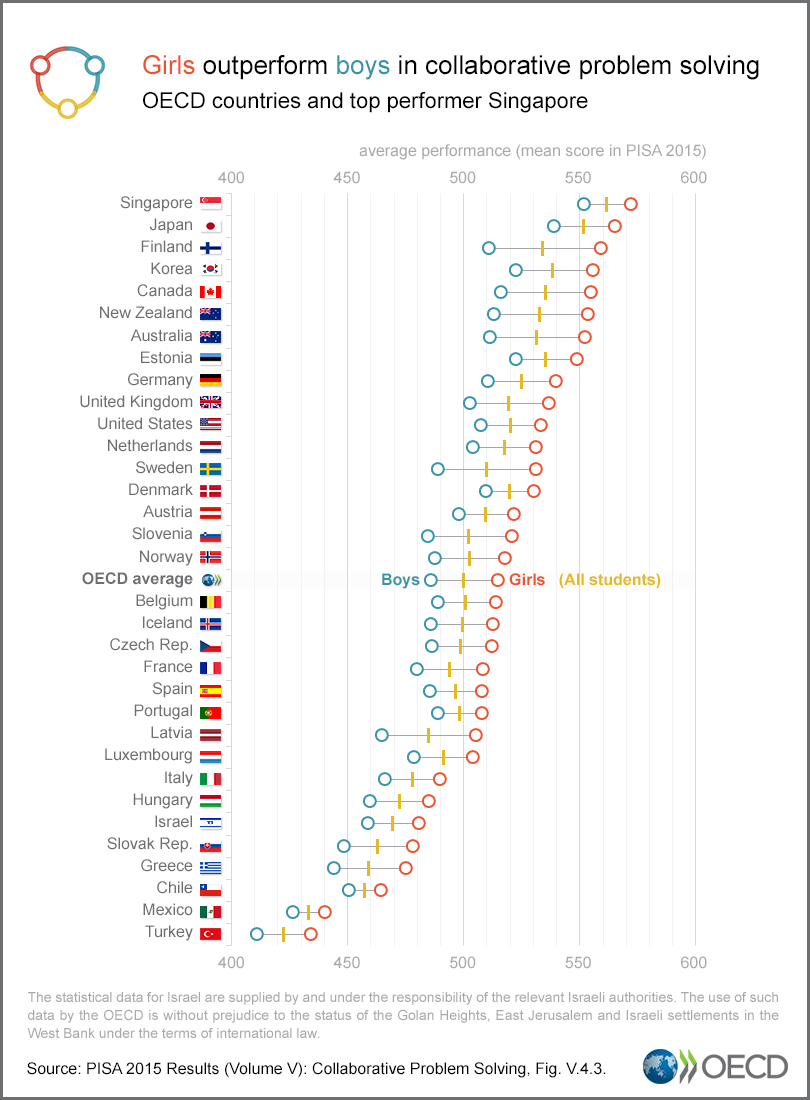
PISA has a long history of assessing students’ problem-solving skills. A first assessment of cross-curricular problem-solving skills was undertaken in 2003; in 2012, PISA assessed creative problem-solving skills. The evolution of digital assessment technologies has now allowed PISA to carry out the world’s first international assessment of collaborative problem-solving skills, defined as the capacity of students to solve problems by pooling their knowledge, skills and efforts with others.

As one would expect, students who have stronger science, reading or mathematics skills also tend to be better at collaborative problem solving, because managing and interpreting information and complex reasoning are always required to solve problems. The same holds across countries: top-performing countries in PISA, like Japan, Korea and Singapore in Asia, Estonia and Finland in Europe, and Canada in North America, also come out on top in the PISA assessment of collaborative problem solving.

But individual cognitive skills explain less than two-thirds of the variation in student performance on the PISA collaborative problem-solving scale, and a roughly similar share of the performance differences among countries on this measure is explained by the relative standing of countries on the 2012 PISA assessment of individual, creative problem-solving skills. There are countries where students do much better in collaborative problem solving than what one would predict from their performance in the PISA science, reading and mathematics assessments. For example, Japanese students do very well in those subjects, but they do even better in collaborative problem solving. By contrast, students in the four Chinese provinces that took part in PISA did well in mathematics and science, but came out just average in collaborative problem solving. In a nutshell, while the absence of science, mathematics and reading skills does not imply the presence of social and emotional skills, social skills are not an automatic by-product of the development of academic skills either.

All countries need to make headway in reducing gender disparities. When PISA assessed individual problem-solving skills in 2012, boys scored higher in most countries. By contrast, in the 2015 assessment of collaborative problem solving, girls outperformed boys in every country, both before and after considering their performance in science, reading and mathematics. The relative size of the gender gap in collaborative problem-solving performance is even larger than it is in reading.

These results are mirrored in students’ attitudes towards collaboration. Girls reported more positive attitudes towards relationships, meaning that they tend to be more interested in others’ opinions and want others to succeed. Boys, on the other hand, are more likely to see the instrumental benefits of teamwork and how collaboration can help them work more effectively and efficiently. As positive attitudes towards collaboration are linked with the collaboration-related component of performance in the PISA assessment, this opens up an avenue for intervention for schools.

There also seem to be factors in the classroom environment that relate to those attitudes. PISA asked students how often they engage in communication-intensive activities, such as explaining their ideas in science class; spending time in the laboratory doing practical experiments; arguing about science questions; and taking part in class debates about investigations. The results show a clear relationship between these activities and positive attitudes towards collaboration. On average, the valuing of relationships and teamwork is more prevalent among students who reported that they participate in these activities more often. For example, even after considering gender, and students’ and schools’ socio-economic profile, in 46 of the 56 education systems that participated in the assessment, students who reported that they explain their ideas in most or all science lessons were more likely to agree that they are “a good listener”; and in 37 of these 56 systems these students also agreed that they “enjoy considering different perspectives”. So there is much that teachers can do to facilitate a climate that is conducive to collaboration.

Many schools can also do better in fostering a learning climate where students develop a sense of belonging, and where they are free of fear. Students who reported more positive student-student interactions score higher in collaborative problem solving, even after considering the socio-economic profile of students and schools. Students who don’t feel threatened by other students also score higher in collaborative problem solving. In contrast, students who reported that their teachers say something insulting to them in front of others at least a few times per year score 23 points lower in collaborative problem solving than students who reported that this didn’t happen to them during the previous year.

It is interesting that disadvantaged students see the value of teamwork often more clearly than their advantaged peers. They tend to report more often that teamwork improves their own efficiency, that they prefer working as part of a team to working alone, and that they think teams make better decisions than individuals. Schools that succeed in building on those attitudes by designing collaborative learning environments might be able to engage disadvantaged students in new ways.

The inter-relationships between social background, attitudes towards collaboration and performance in collaborative problem solving are even more interesting. The data show that exposure to diversity in the classroom tends to be associated with better collaboration skills.

Finally, education does not end at the school gate when it comes to helping students develop their social skills. It is striking that only a quarter of the performance variation in collaborative problem-solving skills lies between schools, much less than is the case in the academic disciplines. For a start, parents need to play their part. For example, students score much higher in the collaborative problem-solving assessment when they reported that they had talked to their parents outside of school on the day prior to the PISA test, and also when their parents agreed that they are interested in their child’s school activities or encourage them to be confident.

PISA also asked students what kinds of activities they pursue both before and after school. Some of these activities – using the Internet/chat/social networks; playing video games; meeting friends or talking to friends on the phone; and working in the household or taking care of family members – might have a social, or perhaps antisocial, component to them. The results show that students who play video games score much lower, on average, than students who do not play video games, and that gap remains significant even after considering social and economic factors as well as performance in science, reading and mathematics. At the same time, accessing the Internet, chatting or social networking tends to be associated with better collaborative problem-solving performance, on average across OECD countries, all other things being equal.

In sum, in a world that places a growing premium on social skills, a lot more needs to be done to foster those skills far more systematically across the school curriculum. Strong academic skills will not automatically also lead to strong social skills. Part of the answer might lie in giving students more ownership over the time, place, path, pace and interactions of their learning. Another part of the answer can lie in fostering more positive relationships at school and designing learning environments that benefit students’ collaborative problem-solving skills and their attitudes towards collaboration. Schools can identify those students who are socially isolated, organise social activities to foster constructive relationships and school attachment, provide teacher training on classroom management, and adopt a whole-of-school approach to prevent and address bullying. But part of the answer lies with parents and society at large. It takes collaboration across a community to develop better skills for better lives.

Links
PISA 2015 Results (Volume V), Collaborative Problem Solving
PISA in Focus No. 77: How does PISA measure students’ ability to collaborate?
PISA in Focus No. 78: Collaborative problem solving 
Programme for International Student Assessment's (PISA)

Register for a public webinar on Tuesday, 21 November, 4:00 pm (Paris time) with Andreas Schleicher, Director of the OECD Education and Skills Directorate, and Jeffrey Mo, an analyst in the PISA programme.

Follow the conversation on twitter: #OECDPISA

Join our OECD Teacher Community on Edmodo